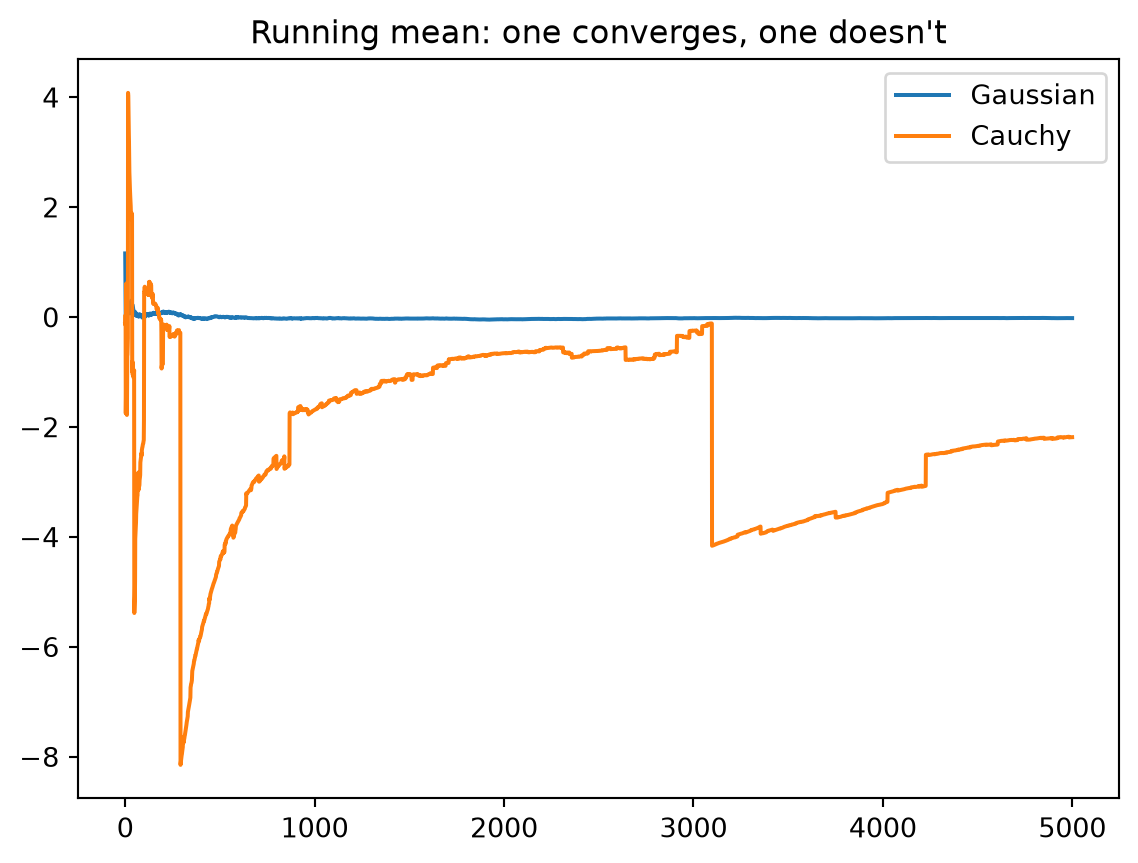
import matplotlib.pyplot as pltfrom dsft.distributions import gaussian_sample, cauchy_sample, meandef running_mean(sample_fn, n): xs = [sample_fn() for _ inrange(n)]return [mean(xs[:i]) for i inrange(1, n +1)]n =5000plt.plot(running_mean(gaussian_sample, n), label="Gaussian")plt.plot(running_mean(cauchy_sample, n), label="Cauchy")plt.legend()plt.title("Running mean: one converges, one doesn't")
Python will always compute sum(xs) / len(xs). That doesn’t mean the number it returns estimates anything.
7.1 Summary
Build it, then watch it fail:
import randomdef mean(xs):returnsum(xs) /len(xs)def running_mean(sample_fn, n): xs = [sample_fn() for _ inrange(n)]return [mean(xs[:i]) for i inrange(1, n +1)]def cauchy_sample():return random.gauss(0, 1) / random.gauss(0, 1)
Plotting running_mean for a Gaussian generator against a Cauchy generator across n = 1 to 50,000 makes the point without needing a proof first: one settles, the other keeps lurching, because the Cauchy mean doesn’t converge to anything — it’s undefined. The takeaway is stated plainly: Python will always compute sum(xs)/len(xs). That doesn’t mean the number it returns estimates anything.